Monday, April 14, 2014

Carrots

Carrots:


I recently wrote about asparagus saying that I associate asparagus with Easter.  A couple of people said they associated carrots with Easter.  Well, I suspect that they associate the carrots with the Easter Bunny.  Actually, rabbits eat the green tops of the the carrot, while we eat the orange root.   Asparagus is a spring vegetable, while locally grown carrots are in season in the summer and fall.  Both vegetables are available year round.  Well, anyway, I've never written about carrots.  So, here goes.

The carrot is a root vegetable.  It is usually orange in color , though purple, red, white and yellow varieties exist.  The carrot has a crisp texture when fresh.  The most frequently eaten part of the carrot is the taproot., although the greens are eaten as well.

The carrot is native to Europe and southwestern Asia.  Today's carrot has been selectively bred for its enlarged and more palatable, less woody-textured edible taproot.   Carrots  get their characteristic orange color from beta-carotene.  Massive overconsumption of carrots can result in carotenosis, a benign condition in which the skin turns yellow.  In fact poultry producers use carrot extracts to alter the color of egg yolk.  Today the largest producer of carrots is China followed by Russia, and then a close third is the U.S.

There are two broad classes of carrot varieties, eastern carrots and western carrots.   Eastern carrots were domesticated in central Asia in the tenth century.  Specimens of eastern carrots that survive today are commonly purple or yellow and often have branched roots.  Western carrots emerged in the Netherlands in the seventeenth century.  They have the orange color from their abundance of carotene.  Today the city of Holtville, California promotes itself as the "Carrot Capital of the World".

Traditional medicine has used the carrot root to increase blood flow to the pelvic area and the uterus, to reduce flatulence, to treat digestive problems, intestinal parasites, and tonsillitus or constipation.   The beta-carotene along with other carotenes in carrots are partly metabolized into vitamin A.  Lack of vitamin A can cause poor vision including night vision, and this can be remedied by adding vitamin A to the diet.

When I started in the produce business carrots came mostly with the tops still attached.  We would give the tops a twist to remove the tops as the bunches were sold.  Today carrots mostly come in a plastic bag with the tops already removed.   We  always were told that carrots were good for your eyes.  My father would say, "You've never seen a rabbit wearing glasses, have you?"

All varieties of carrots contain valuable amounts of antioxidant nutrients.  In a recent study of fruit and vegetable intake by color orange/yellow were found to be most productive against cardiovascular disease, and carrots were found to be the single most risk reducing food.   The anticancer benefits of carrots have been best researched in the area of colon cancer.

Carrots can be chopped and boiled, fried, or steamed, and cooked in soups and stews as well as baby and pet foods.   So called baby carrots or mini carrots are just regular carrots cut down.  Together with onion and celery carrots are one of the primary vegetables used in a "mirepoix" to make various  broths.

Select carrots that are firm , smooth, relatively stright and bright in color. Avoid carrots that are excessively cracked or forked as well as those that are limp or rubbery.   The trick to storing carrots is to minimize the amount of moisture they loose.  Store them in a plastic bag or wrapped in paper towel in the coolest part of the refrigerator.  They should last a good two weeks.  Carrots should be stored away from apples, pears, potatoes, and other fruits and vegetables that produce ethylene gas, since it will cause them to become bitter.

So....Eat up!  Enjoy! I'll show you how.

Simple but good:

.Minted Carrots with Pumpkin Seeds:

6 medium sized carrots peeled and cut into turned pieces
1/2 tablespoon fresh chopped parsley
1 tablespoon fresh chopped mint
1 tablespoon chopped pumpkin seeds
2 tablespoons lemon juice
extra virgin olive oil to taste
salt and cracked black pepper to taste

Bring slightly salted water to a boil in a steamer.  Steam carrots until al dente'.   Combine rest of ingredients and toss with carrots. 
(Turned carrots: Peel and cut off ends of carrot. Make a diagonal cut1/2 inch from the tip of the carrot.  Turn the carrot so the diagonal cut is going in the opposite direction of you knife. Make another cut.)


Monday, April 7, 2014

Asparagus Revisited


ASPARAGUS:

When I was young, I always associated asparagus with Easter, because they would be available in the spring.   Now asparagus is available pretty much year round from various growing areas.   Still I always like to have asparagus around Easter.   So, with Easter just two weeks away, I will "re-visit" asparagus.

Asparagus is a spring vegetable.  This member of the lily family has been used over the years  as both a vegetable and a medicine.   In ancient times it was known in Syria and Spain.  Greeks and Romans ate it fresh and dried it for use in the winter.  A recipe for cooking asparagus is in the oldest surviving book of recipes. 

 Asparagus basically comes in three colors: green, white and purple.  Most of the  asparagus we eat is green.  White asparagus is green asparagus that has been  covered with soil to bleach out the color.  It tastes about the same but tends to have a more tender texture.  Purple asparagus is purple at the tip and at leaf points and tends to have a pale stalk.  Asparagus has a delicate flavor.  Only young asparagus shoots are eaten.  Once the buds start to open the shoots quickly turn woody. 

I remember my dad always called asparagus "grass".    Years later working in Florida I never heard "grass" until I met a New York transplant produce guy who also called it "grass".  I don't know.  May it is a New York thing.   Asparagus is usually displayed in bunches held together by two rubber bands.  I remember one time we displayed the asparagus standing up loose in pans of water.  Some of the customers  were breaking off the bottoms of the stems, which is usually done at home.   I thought this was completely lacking in class and a way to pay less.  I was informed by a senior citizen that we invited people to do this by displaying the asparagus  loose.  Needless to say we always bundled them after that. 

 Asparagus is prepared and served around the world typically as an appetizer or vegetable side dish .  Asparagus is generally thought of as a spring vegetable and the North American peak of season is April to June.  Today however asparagus is available year round from various growing areas. 

Asparagus are loaded with nutrients, fiber, folate, vitamins A, C, E, and K  and also chromium.  They are a rich source of glutathione, a detoxifying compound that helps break down carcinogens and other harmful compounds like free radicals.  Asparagus is packed with antioxidants and contains folate which works with vitamin B12 to help prevent cognitive impairment.

Select asparagus with smooth skin, bright green color, compact heads, and freshly cut ends.  Fresh asparagus should have no odor.   Stem thickness indicates age of the plants.  Thicker stems from older plants can be woody. 

To prepare asparagus hold  both ends and bend until the stalk breaks.  Then roast, grill or stir-fry.  These waterless methods help preserve nutritional content  and antioxidant power.  You can also boil or steam for 5-8 minutes.  Asparagus can be eaten raw  just thoroughly wash with warm water to remove any sand.  Asparagus can also be marinated.  

Lastly, eating asparagus gives the eater's urine a disagreeable odor.  This smell is due to the product formed as a derivative during the digestion and subsequent breakdown of beneficial amino acids that occur naturally in asparagus.   It's normal.

So .......... Eat up!  Enjoy!    I'll show you how.


Simple but good:


Roasted Asparagus

1 bunch thin asparagus
3 tablespoons of olive oil
1 1/2 tablespoons Parmesan cheese
1 clove garlic, minced
1 teaspoon sea salt
1/2 teaspoon ground black pepper
1 tablespoon lemon juice. 

Preheat oven to 425 degrees F. Trim the tough stalks off the bottom of the asparagus and place in a mixing bowl and drizzle on olive oil and toss to coat.    Sprinkle with Parmesan cheese, garlic, salt and pepper.  
Arrange asparagus onto a baking sheet in a single layer.  Bake until tender, about 12 to 15 minutes.  Sprinke with lemon juice just before serving.


Wednesday, April 2, 2014

Rhubarb


Rhubarb:

Rhubarb is a herbaceous perennial growing from  short thick rhizomes.  It has large leaves that are somewhat triangular with long fleshy petioles (leaf stalks).  In culinary use the fresh stalks are crisp with a strong tart taste.  The plant stalks are cooked in sugar and used in pies and other desserts.

Washington is the leading rhubarb producer in the U.S..  Oregon, Michigan, and California  are also rhubarb producers.  There are two types of rhubarb: hothouse rhubarb and field rhubarb.  Hothouse rhubarb, sometimes called strawberry rhubarb due to its pinkish hue, is general smaller and less stringy than field rhubarb.  It is also less coarsely textured and sweeter.  Fiels grown rhubarb has a more pronounced tart rhubarb flavor.  The stalks are darker red and thus this is called cherry rhubarb.

Rhubarb is usually considered a vegetable, but we most often use it as a fruit.  In 1947 a New York court ruled that since it was used as a fruit in the U.S. , rhubarb was counted as a fruit for purposes of regulations and duties thereby lowering tariffs on imported rhubarb.

Rhubarab contains glycosides, especially glucoheins and emodin which impart cathartic and laxative properties.  In traditional Chinese medicine rhubarb roots have been used as a laxative for several thousand years.  Rhubarb is 95% water and contains a fair amount of potassium.  It is rich in vitamin C, dietary fiber, and calcium.

Rhubarb leaves contain poisonous substances, including oxalic acid, which is a nephrotoxic and corrosive acid. It is important to cut all of the leave away from the stalk before using.

Hot house rhubarb is available from Januaray through April and field rhubarb begins in March and runs through August into early fall.  The peak period is April and May.  Choose firm crisp stalks with no spots or dark patches.  Today rhubarb is usually sold with the  leaves already cut off.  Avoid rhubarb that has wilted leaves or flabby stalks.   After removing any leaves store rhubarb unwashed in the refrigerator for up to a week.  In a sealed plastic bag  it will last even longer.

Rhubarb requires sweetening to minimize its extreme tartness.  It can be served as a sauce over ice cream, combined with fresh strawberries, or made into pies, tarts, puddings, bread, jellies, and beverages.  For cooking the stalks are usually cut into one inch pieces and stewed (boiled in water).  It is only necessary to barely cover the rhubarb with water since it contains a good deal of water of its own.   One half to three-quarters of a cup of sugar is added for each pound of rhubarb.  Spices such as cinnamon and/or nutmeg can be added to taste.  Sometimes  a tablespoon of lime or lemon juice is added.  The stalk pieces are then boiled until soft.

So.......Eat up!  Enjoy!  I'll show you how.

Simple but good:


Rhubarb Pie:

4 cups chopped rhubarb
1 1/3 cuos white sugar
6 tablespoons all purpose flour1 tablespoon butter butter
1 recipe pastry for 9 inch double crust pie

Preheat oven to 450 degrees F.  Combine sugar and flour.  Sprinke 1/4 over pastry pie plate.  Heap rhubarb over the mixture.  Sprinke with the remaining sugar and flour.  Dot with small pieces of butter.  Cover with top crust.  Place pie on lowest rack of oven and bake for 15 minutes.  Reduce oven temp to 350 degrees F and continue baking for 40 to 45 minutes.  Serve hot or cold. 


Wednesday, March 12, 2014

Papaya


Papaya:


The papaya or "paw paw" is the fruit of the plant "Carica papaya".  It is native to the tropics of the Americas perhaps from southern Mexico and neighboring Central America. The papaya is said to have been called "fruit of the angels" by Christopher Columbus.  

The papaya is a large tree-like plant with a single stem.  Two kinds of papayas are commonly grown.  One has sweet red and orange flesh and the other has yellow flesh.   The large-fruited red-fleshed Maradol, Sunrise, and Caribbean papayas often sold in the U.S. are commonly grown in Mexico and Belize. 

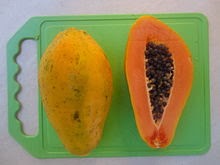
Papayas are spherical or pear-shaped fruits that can be as long as 20 inches.  The ones found in the market, however,  usually average around 7 inches.   Papayas can be used as a food, a cooking aid, and in traditional medicine.   Green papaya fruit is rich in papain, a protease used for tenderizing meat and other proteins.   Papaya has a soft butter-like consistency and a sweet musky taste.

Papaya is a source of provitamin A, carotenoids, vitamins C and E, folate, potassium,  and dietary fiber.   The fruit is ripe when it feels soft and its skin has attained an amber to orange hue.   The ripe papaya is usually eaten raw without the skin or seeds.  The unripe green fruit can be eaten cooked, usually in curries, salds, and stews.   Papayas have a relatively high amount of pectin, which can be used to make jellies.  The black seeds are edible and have a sharp spicy taste.  They are sometimes ground and used as a substitute for black pepper. Papayas are available year round with peak season in early summer and fall.   

Papaya is a good immune system booster due to its antioxidant vitamins C, A, and E.  These antioxidants along with flavanoids and carotenes help protect against cancers.  Papaya's high enzyme content aids in digestion and also with its content of papain and chymopapain and antioxidanat vitamins reduce inflammation.  Due to high water content and high amounts of soluble fiber papaya promotes normal bowel movement and helps lower cholesterol.  

Choose papayas that have a reddish-orange skin and are slightly soft to the touch.    Avoid those that are totally green or overly hard unless you plan on cooking them.    Papayas that are partially yellow should be left at room temperature, where they will ripen in a few days.   If you want to speed up the ripening, you can place the papaya in a paper bag with a banana.   A ripe papaya can be stored in the refrigerator for one or two days.  

To prepare papaya rinse off the papaya with cold water.  Cut lengthwise.  Scoop out the seeds with a spoon.   You can scoop out the papaya flesh, or turn over the papaya and slice off the skin with a knife. It can then be sliced into wedges or cut to smaller pieces.  

Here are some quick serving ideas: 
1. Sprinkle  a small papaya with fresh lime juice  and enjoy as is.
2. Slice a small papay lengthwise, remove seeds and fill with fruit salad.
3. In a blender combine papaya, strawberriesand yogurt for a cold soup.
4. Mix diced papaya, cilantro, jalapeno pepper, and ginger for a salsa.  It goes great with shrimp, scallops, of hallibut. 

So..... Eat up!  Enjoy!  I'll show you how.

Wednesday, March 5, 2014

Rapini (Broccoli rabe)


Rapini:

Rapini, also called "Broccoli Rabe" pronounced "broccoli rob", is a green cruciferous vegetable and member of the turnip family. Contrary to its name, it is not a member of  the broccoli family.  The leaves, buds, and stems are all edible.  The buds resemble broccoli, but do not form into a head.  Rapini is known for its slightly bitter taste and is associated with Italian, Galician, and Portugese cuisines.  Rapini's flavor is described as nutty, bitter, and pungent.  

Rapini is grown throughout the world, and is available all year long, but its peak season in the Northern Hemisphere is fall to spring.  Rapini is always sold fresh.  I have never seen it canned or frozen.  Rapini is known by many names throughout the world. The stangest name though is "taitcat".  I've never heard that name before and do not know anything about its origin. 

Growing up I had heard of "Broccoli rabe".  I never heard the name "Rapini" until later in the supermarket.  Broccoli rabe was not something was my mother cooked.  I guess my parents weren't fond of its bitterness.  When thinking about Broccoli rabe, I always think of my cousin, Bobby.  Actually, he was a butcher by trade,  but after many years with a butcher shop he expanded into produce as well.   He would prepare Broccoli rabe.  It was great. 

Broccoli rabe is nutrient dense and has many health benefits.  Here are some of the claims made for Broccoli rabe:  It slows aging, strengthens bones, decreases risk of hypertension, lessens inflammation, prevents cancer, Alzheimers, strokes, and birth defects. Rapini has cancer preventing properties due to bioactive compounds called sulforaphanes.  These phytonutrients may protect agains cancers of the stomach, lung, esophagus, colon, and breast.  It also contains lutein, a phytonutrient that protects the retina of the eye from oxidative damage and may slow the progression of macular degeneration and cataracts.

Choose rapini with large dark green leaves that are crisp, upright, and not wilted.  Avoid ones with leaves that are wilted  yellowing, or have dark green patches of slime.  Refrigerate rapini  unwashed, loosely wrapped in a plastic bag for up to 3 days. 

The tough stem bottoms of rapini are easily removed before cooking.  Blanching for one minute will reduce bitterness.  Rapini can be steamed, saute'ed, stir fried, or braised.  It combines well with pasta and rice.  To prepare remove the tough bottoms of the stem, about a half inch, and rinse.  Cut crosswise into two inch pieces.  Drop into salted boiling water for one to two minutes.  Remove from water with a slotted spoon.  Saute the blanched rapini in olive oil and garlic for 3 to 5 minutes until tender.   It can be mixed with any number of things ( onions, tomatoes, sausage, etc)  and used as a side dish or as a topping for pasta.

So.... Eat up!  Enjoy!  I'll show you how.

Tuesday, February 25, 2014

Beans

Beans:

Bean is a common name for the large plant seeds used for human food or animal feed of several genra of the family "Fabaceae" (alternately called "leguminosae"). It originally referred to the seed of the broad or fava bean.  Native Americans often grew beans alongside corn and squash referring to the trio as the "Three Sisters".  The corn stalk acted as support for the beans.  In more recent times the so called "bush bean" has been developed which does not require support and has all its pods develop simultaneously rather than gradually.  This makes the "bush bean" more practical for commercial production.  

Dry beans come from both the Old World variety of broad beans (fava beans) and the New World varieties of kidney, black, cranberries (not to be confused with the fruit), pinto and navy/haricut beans.  Beans are a heliotropic plant , meaning that the leaves tilt throughout the day to face the sun.  At night they go into a folded "sleep" position.   Beans, of course, are members of the "legume" family, plants that contain several seeds in a pod and grow on bushes or vines.  

My first memories of beans were at my grandpa's store.  They were one of the items that was displayed on the outside stand.  They were in a bushel basket that had its bottom filled so that there was only a 2 inch deep area to fill with beans.   They were fava beans and I remember being told they were "good eating".   It's funny how that stays with me.  In later years in the supermarkets I did not see too many fresh beans.  They would have fresh black eyed peas  in a cellophane package around the New Year.   Most of the beans people buy and eat today are either canned or dried.

Beans are the world's most significant source of vegetable protein.   Beans also contain antioxidants, complex carbohydrates, folate, and iron.  Beans have significant amounts of fiber and soluble fiber with one cup providing between nine and thirteen grams of fiber.  Soluble fiber can help lower blood cholesterol and increase good cholesterol.

Currently there are about 40,000 bean varieties, although only a fraction are mass produced for regular consumption.  The world's largest producers of beans are India, Brazil, Burma, Peoples Republic of China, and the U.S.

Here is a short list of commonly found in the supermarket beans with their typical uses:

  • Adzxuki beans: (also known as field peas or red oriental beans)  Used in soups, sweet bean paste, and Japanese and Chinese dishes.
  • Anasazi beans: (also known as Jacob's cattle beans)  Used in soups and Southwestern dishesand can be used in recipes that call for pinto beans.
  • Black beans: (also known as cowpeas)  Used in soups, stews, rice dishes and Latin American cuisine.
  • Chickpeas: (also known as garbanzo or ceci beans)  Used in casseroles, hummus, minestrone soup and Spanish and Indian dishes.
  • Edamame: (also known as green soybeans)  Used in snacks, salads, casseroles and rice dishes.
  • Favas beans: (also know as broiad or horse beans)  Used in stews and side dishes
  • Lentils: Used in soups, stews, salads, side dishes and Indian dishes.
  • Lima beans: (also known as butter or Madagascar beans)  Used in succotash, casseroles, soups, and salads.
  • Kidney beans: (also called red kidney beans or white kidney beans)  Used in salads, stews, chili and rice dishes.
  • Soy nuts: (also known as roasted soybeans or soya beans)  Used for snacks or garnish for salads.

So... Eat up!  Enjoy!  I'll show you how.


Simple but good:

Easy Pasta Fasul

2     cloves garlic, chopped
1/2  small yellow onion, chopped 
2 tablespoons extra virgin olive oil
1 can Cannellini beans (15.5 oz )
1 can Italian diced tomatoes (14.5 oz.)
Salt and pepper to taste
Parmesan cheese for sprinkling on top.
1/2 cup ditalini, cooked

In a hot pan put 2 tablespoons of extra virgin olive oil.  Add chopped garlic and onion.  Sprinke with salt and pepper.  Sautee' until soft, about 2 minutes.  Drain and rinse can of Cannellini beans.  Add to pan and stir for a couple of minutes  so the beans will pick up the garlic and onion flavor.  Add the can of tomatoes including liquid.  Stir and cook for a few minutes so as to heat throughout.  Add ditalini and stir.   Cook a couple more minutes to make sure it is heated throughout.   Serve hot and garnish with Parmesan cheese. 

Friday, February 14, 2014

Coconuts


Coconuts:

The coconut palm (cocos nucifera) is a member of the palm family.  The term "coconut" can refer to the entire coconut palm, the seed, or the fruit.  The coconut, botanicaally speaking,  is actually  a drupe rather than a nut.  The term comes from 16th century Portugese and Spanish "coco" meaning "head" or "skull"from the three indentations on the coconut that resemble facial features.    Coconuts are found throughout the tropics and subtropical areas.   Coconuts are different from any other fruit because they contain a quantity of "water" inside their shell.

The coconut has three layers.  The outermost layer which is smooth with a greenish color is called the exocarp.   The fibrous husk which ultimately surrounds the hard woody layer is the mesocarp.  The hard woody layer which surrounds the seed is the endocarp.  In the coconuts you find in the store the exocarp and mesocarp are removed and you see only the endocarp.

As the coconut develops its endosperm is initially in its nuclear phase suspended within the coconut water.  As development continues cellular layers of endosperm deposit along the walls of the coconut becoming the edible coconut flesh.  When dried the coconut flesh is called copra.  The oil and milk derived from it are commonly used in cooking and frying.  Coconut oil is also widely used in soaps and cosmetics.  The clear liquid coconut water within the coconut is a refreshing drink.

The coconut palm is grown throughout the tropics for decorating as well as for its culinary and nonculinary uses.  Virtually every part of the coconut palm can be used by humans in some manner and has significant economic value.   Coconut palms are grown in more than 80 countries.  In the U.S. coconut palms can be grown and reproduced outdoors without irrigation in Hawaii, southern Florida and the territories of Puerto Rico, Guam, American Samoa, the U.S. Virgin Islands, and the Commonwealth of the Northern Mariana Islands.

Coconut seeds provide oil for cooking and frying and making margarine.  The white fleshy part of the seed, the coconut meat, is used fresh or dried in cooking confections and desserts.  Coconut milk is frequently used in curries and savory dishes.  Coconut flour has been developed for use in baking to combat malnutrition.  Dried coconut is used in the filling if many chocolate bars.    Coconut water contains sugar, dietary fiber, proteins, antioxidants, vitamins, and minerals and provide isotonic electrolyte balance.  In fact during WW II  coconut water was used as an  IV drip.

Growing up I first remember eating coconut at my maternal grandmother's.  She always had such a variety of different fruits and vegetable in the house.  Some years later while still living in New York my parents brought back a whole coconut from a trip to Florida.  I had never seen the green outer layer before.   I  tried to cut and peel that fibrous layer to get down to the layer I was used to seeing, but I ended up with a hacked up mess in the end.  One for the coconut; zero for Tom!

Published studies in medical journals show that coconuts in one form or another may provide a wide range of health benefits.  Coconut can kill viruses  such as influenza, herpes, measles, and hepatitis C.   It kills bacteria that causes ulcers, throat infections, urinary tract infections, gum disease and cavities.  It can kill fungi and yeasts.   The husks and shells can be used for fuel and are a source of charcoal.  Coconuts are used in the beauty industry in moisturizers and body butters, because coconut oil is readily absorbed by the skin.

Fresh coconut is available year round, but peak season is October through December.  Select a coconut that is heavy.  Shake it and listen for the liquid sloshing around inside.  There are 3 "eyes" or indentations fairly close together on the shell. This is where the coconut is softest and thinest.  There should be no moisture or smell of fermentation around the "eyes".    Coconuts will keep at room temperature for 3 - 4 weeks.  They'll last even longer in the refrigerator but the water inside will dry up.   Once opened a coconut must be wrapped and refrigerated and it will only keep for 2 - 3 days.   To store longer you can grate it then freeze it, or dehydrate it and store tightly covered.

To prepare a coconut drive a screwdriver or nail into the "eyes and drain the liquid.  Then place the coconut in an oven at 250 - 325 degrees F. and roast for about 15 minutes.  This will make the shell easier to crack and cause the flesh to shrink slightly away from the shell.  Remove the coconut from the oven and tap it with a hammer and it should break easily, and the shell should be easy to remove.

Fresh coconuts are in the Produce department but you will also find shredded coconut with baking goods.  Look some more and you will also find coconut milk, coconut water, and coconut oil.  It's all great and  good for you stuff.

So.... Eat up!  Enjoy!  I'll show you how.