Showing posts sorted by relevance for query bell peppers. Sort by date Show all posts

Wednesday, April 17, 2013

Peppers

Peppers:


Peppers are native to Mexico, Central America, and northern South Africa.  Pepper seeds were carried to Spain in 1493 and spread to other European countries, Africa, and Asian counties.  Today China is the world's largest producer of peppers.

Peppers come in all different sizes and shapes.  They range in flavor from very sweet and mild to so hot they can actually burn the skin.  Bell peppers are known as sweet peppers.  The red bell pepper is actually a ripened green bell pepper.   The Italian sweet frying pepper, also called a Cubanelle, is not  a bell pepper or a chile pepper.  It is normally a light green color but can be orange to red.  As the name implies it is on the sweet side.  Then there are the chile peppers.  They contain capsaicin, a chemical that produces a strong burning sensation on the mucous membranes.  Generally speaking, the smaller the pepper the hotter the taste, but this can vary depending on local growing conditions.

Supplies of bell peppers from California, Florida, and Mexico have overlapping growing seasons.  This ensures a year round supply with various peak times.  Chile peppers are also generally available year round.

The smell of peppers reminds me of my maternal grandmother's kitchen.  She and my grandfather had a fruit and vegetable store for a time before I was born.   She always had a variety of fruits and vegetables on hand.  As a kid I remember having salami and fried peppers on a roll at the beach on Coney Island.  Later in the supermarket in Florida there was a customer who would come in looking for damaged produce to buy at a discount.  Many times we sold her cracked or wrinkled peppers.  She would take them home, cook them, and bring them back with bread and cheese  for us to make sandwiches.   They were so delicious.  Her name was Ida and she was an Italian from New Jersey, but we called her "the grandma lady".  She just looked like a gandma.

All peppers are rich in vitamins A, C, and K , but red peppers are bursting with them.  Red peppers are a good source of lycopene.  Vitamins A asnd C are antioxidants and help prevent cell damage, cancer, diseases relating to aging, and support immune function.  Lycopene is earning a reputation for helping to prevent prostate cancer and cancer of the bladder, cervix, and pancreas.  Finally peppers are rich in phytochemicals with a decent amount of fiber.

Select peppers that have a glossy sheen and no shrivelling, cracks or soft spots. Store sweet peppers in a plastic bag in your refrigerator's crisper drawer. Green peppers stay firm for a week and other colors go soft in 3 or 4 days.  Hot peppers do better refrigerated in a perforated paper bag.

Hot peppers' fire comes from capsaicin which acts on the pain sensors rather than the taste buds.  Capsaicin has been shown to decrease blood cholesterol and triglycerides, boost immunity, and reduce the risk of stomach ulcers.

The hotness of peppers is measured according to the Scoville Heat Index. .  The mildest peppers are at the bottom.  Most of the heat in peppers is found in the seeds and rib membranes.  To reduce some heat remove the seeds and membranes.  Here is a short list of some peppers and their Scoville Units:

16 million                              - pure capsaicin
 5 million                               - Law enforcement pepper spray
100,000 - 350,000                 - Habanero pepper, Scotch bonnet pepper
 30,000 -  50,000                   - Cayene peppers
 10,000 -  25,000                   - Serrano pepper
  2,500 -    8,000                    - Jalapeno pepper, Paprika, Tabasco sauce
     500 -    2,500                    - Anaheim pepper, Poblano pepper
     100 -       500                    - Pimento, Banana pepper, Peperoncini
          -  0 -                             - Bell peppers

Handle hot chile peppers with care.  Wash your hands thoroughly after preparing them.  Not only will the residue burn your lips and eyes, it will transfer to other fruits and vegetable.

So......... Eat up !  Enjoy !  I'll show you how.

Simple but Good:

Fried Cubanelles:

Several cubanelle peppers
4 or 5 cloves of garlic, very thinly sliced
Extra virgin olive oil
garlic powder
salt and black pepper

Take the peppers and slice off the tops close to the stems.  Cut down one side of the pepper and open it up.  Remove the seeds and ribs.

Place about 1/8 inch of extra virgin olive oil in a pan and heat.  Put in the garlic and sautee for a couple of minutes until the garlic begins to brown.  Remove the garlic to a paper towel to drain.  Put peppers in pan and stir to cook.  When the peppers start to get soft add back the garlic and lower the heat to low medium.  Give a generous sprinkle of garlic powder and add salt and black pepper.  Cover and cook until peppers begin to brown.  Remove to shallow dish and let sit at room temperature to cool and marinate.

Enjoy with crusty bread by dipping the bread in the oil and eating it  with the peppers.


Tuesday, June 9, 2015

Peppers Revisited

Peppers:

About:

Peppers come in all different sizes and shapes.  They range in flavor from very sweet and mild to so hot they can actually burn the skin.  Bell peppers are known as sweet peppers.  The red bell pepper is actually a ripened green bell pepper.   The Italian sweet frying pepper, also called a Cubanelle, is not  a bell pepper or a chile pepper.  It is normally a light green color but can be orange to red.  As the name implies it is on the sweet side.  Then there are the chile peppers.  They contain capsaicin, a chemical that produces a strong burning sensation on the mucous membranes.  Generally speaking, the smaller the pepper the hotter the taste, but this can vary depending on local growing conditions.

History:

Peppers are native to Mexico, Central America, and northern South Africa.  Pepper seeds were carried to Spain in 1493 and spread to other European countries, Africa, and Asian countries.  Today China is the world's largest producer of peppers.

My Story:

The smell of peppers reminds me of my maternal grandmother's kitchen.  She and my grandfather had a fruit and vegetable store for a time before I was born.   She always had a variety of fruits and vegetables on hand.  As a kid I remember having salami and fried peppers on a roll at the beach on Coney Island.  Later in the supermarket in Florida there was a customer who would come in looking for damaged produce to buy at a discount.  Many times we sold her cracked or wrinkled peppers.  She would take them home, cook them, and bring them back with bread and cheese  for us to make sandwiches.   They were so delicious.  Her name was Ida and she was an Italian from New Jersey, but we called her "the grandma lady".  She just looked like a gandma.

Health Benefits:

All peppers are rich in vitamins A, C, and K , but red peppers are bursting with them.  Red peppers are a good source of lycopene.  Vitamins A asnd C are antioxidants and help prevent cell damage, cancer, diseases relating to aging, and support immune function.  Lycopene is earning a reputation for helping to prevent prostate cancer and cancer of the bladder, cervix, and pancreas.  Finally peppers are rich in phytochemicals with a decent amount of fiber.


Pepper Heat:

Hot peppers' fire comes from capsaicin which acts on the pain sensors rather than the taste buds.  Capsaicin has been shown to decrease blood cholesterol and triglycerides, boost immunity, and reduce the risk of stomach ulcers.

The hotness of peppers is measured according to the Scoville Heat Index. .  The mildest peppers are at the bottom.  Most of the heat in peppers is found in the seeds and rib membranes.  To reduce some heat remove the seeds and membranes.  Here is a short list of some peppers and their Scoville Units:

16 million                              - pure capsaicin
 5 million                               - Law enforcement pepper spray
100,000 - 350,000                 - Habanero pepper, Scotch bonnet pepper
 30,000 -  50,000                   - Cayene peppers
 10,000 -  25,000                   - Serrano pepper
  2,500 -    8,000                    - Jalapeno pepper, Paprika, Tabasco sauce
     500 -    2,500                    - Anaheim pepper, Poblano pepper
     100 -       500                    - Pimento, Banana pepper, Peperoncini
          -  0 -                             - Bell peppers

Handle hot chile peppers with care.  Wash your hands thoroughly after preparing them.  Not only will the residue burn your lips and eyes, it will transfer to other fruits and vegetable.

Season:

Supplies of bell peppers from California, Florida, and Mexico have overlapping growing seasons.  This ensures a year round supply with various peak times.  Chile peppers are also generally available year round.


Selecting and Storing:

Select peppers that have a glossy sheen and no shrivelling, cracks or soft spots. Store sweet peppers in a plastic bag in your refrigerator's crisper drawer. Green peppers stay firm for a week and other colors go soft in 3 or 4 days.  Hot peppers do better refrigerated in a perforated paper bag.


So......... Eat up !  Enjoy !  I'll show you how.


Simple but Good:

Fried Cubanelles:

Several cubanelle peppers
4 or 5 cloves of garlic, very thinly sliced
Extra virgin olive oil
garlic powder
salt and black pepper

Take the peppers and slice off the tops close to the stems.  Cut down one side of the pepper and open it up.  Remove the seeds and ribs.

Place about 1/8 inch of extra virgin olive oil in a pan and heat.  Put in the garlic and sautee for a couple of minutes until the garlic begins to brown.  Remove the garlic to a paper towel to drain.  Put peppers in pan and stir to cook.  When the peppers start to get soft add back the garlic and lower the heat to low medium.  Give a generous sprinkle of garlic powder and add salt and black pepper.  Cover and cook until peppers begin to brown.  Remove to shallow dish and let sit at room temperature to cool and marinate.

Enjoy with crusty bread by dipping the bread in the oil and eating it  with the peppers.


(adsbygoogle = window.adsbygoogle || []).push({});
amzn_assoc_ad_type = "contextual"; amzn_assoc_tracking_id = "fruita0f-20"; amzn_assoc_marketplace = "amazon"; amzn_assoc_region = "US"; amzn_assoc_placement = "OZL7KATSDNEQZ7CN"; amzn_assoc_linkid = "OZL7KATSDNEQZ7CN"; amzn_assoc_emphasize_categories = ""; amzn_assoc_fallback_products = ""; amzn_assoc_width = "300"; amzn_assoc_height = "250";

Friday, July 15, 2016

Ratatouille

Ratatouille:

About:

Ratatouille (ra - ta - too - ee) is a traditional French Provencal dish originating in Nice.  Commonly reffered to as 'ratatouille nicoise', ratatouille is popular along the entire Mediterranean as an easy summer dish.
Ratatouille is usually served as a side dish with dinner, but is also used in breakfast and lunch settings.  Ratatouille is sometimes eaten as a meal of its own accompanied by pasta, rice or bread. 


Tomatoes lay a foundation for sautee'd garlic, onions, zucchini, eggplant, bell peppers, marjoram, fennel, and basil. or bay leaf and thyme, or a mix of green herbs like herbs de Provence.  It is usually prepared as a stew of squash.

History:

The word 'ratatouille' comes from Occitan ratatolha and the recipe comes from Occitan cuisine.  Related dishes exist in many Mediterranean cuisines.  The name "ratatouille" for the dish first appeared in print in 1930, but the word has been used since the late 18th century.  Ratatouille is also the name of a 2007 American computer-animated comedy film produced by Pixar and released by Buena Vista Pictures Distribution, featuring an anthropomorphic rat who aspires to cook.

My Story:

I had actually never heard of ratatouille until the movie came out.  I was familiar with caponata, which is an Italian version of ratatouille.  I like caponata very much.  The first time I had ratatouille was at a family dinner at a fish restaurant.  One of our nephews was working at this restaurant as a waiter, and it was decided that we would all go out to dinner there one night.  Well, ratatouille was on the menu, so I ordered it.  It was delicious.  So, now when I think of ratatouille, I think of that dinner with everyone there at a long table eating ratatouille. 

Ratatouille Methods:

There is much debate on how to make traditional ratatouille .  One method is to simply saute' all the vegetables together.  In the layering method approach eggplant and zucchini are sautee'd separately and the tomatoes, onion, garlic and bell peppers are made into a sauce.  The ratatouille is then layered in a casserole-eggplant, zucchini, and tomato/pepper mixture- then baked in  the oven.  A 3rd method is to combine all the ingredients in a large pot and simmer.
Joel Rabuchon in 'The Complete Rabuchon' states, "The secret of a good ratatouille is to cook the vegetables separately so that each will taste truly of itself."

Feeling adventurous?  Try ratatouille !

Eat up!  Enjoy!  I'll show you how.


Recipe for Ratatouille:

1 medium onion, thinly sliced
2 cloves garlic, minced
5 TBS olive oil
3/4 lb. eggplant, cubed 
1 small zucchini, quartered an d cut into small pieces
1 red bell pepper, chopped 3/4 lb. ripe tomato, coarsely chopped
1/4 tsp dried oregano, crumbled
1/4 tsp dried thyme, crumbled
1/8 tsp ground coriander
1/4 tsp fennel seed
3/4 tsp salt
pepper to taste
1/2 c. shredded fresh basil leaves

In a large skillet cook onion and garlic in 2 TBS olive oil until onion is soft..  Add remaining 3 TBS oil and heat through.  Add eggplant, cook 8 minutes stirring occaisonally.  Stir in the zucchini and bell pepper and cook for 12 minutes stirring occaisonally.  Stir in tomatoes and cook 5 minutesor until tender.  Stir in oregano, thyme, coriander, fennel seeds, salat, and pepper.  Cook for 1 minute.  Stir in basil and combine well.  
Ratatouille may be made 1 daay in advance.  Keep covered and chilled.  Reheat before serving. 


(adsbygoogle = window.adsbygoogle || []).push({});

amzn_assoc_ad_type = "contextual"; amzn_assoc_tracking_id = "fruita0f-20"; amzn_assoc_marketplace = "amazon"; amzn_assoc_region = "US"; amzn_assoc_placement = "OZL7KATSDNEQZ7CN"; amzn_assoc_linkid = "OZL7KATSDNEQZ7CN"; amzn_assoc_emphasize_categories = ""; amzn_assoc_fallback_products = ""; amzn_assoc_width = "300"; amzn_assoc_height = "250";

Saturday, March 30, 2019

Foods That Help You Live Longer

Foods That Help You Live Longer:


These are Foods that are scientifically proven to help you live longer and healthier lives.  The information is from a video posted by Chiropractor Dr. Alan Mandell.
The foods listed foods are anti-inflammatory, high in antioxidants, high in fiber, and also high in Omega 3 fatty acids.  I believe you should include as many of these foods as you can in your diet for a longer and healthier life.  I have included links to posts from this blog next to most of the foods. 

1.  Leafy Greens (spinach, kale, arugula) 

2.  Extra Virgin Olive Oil

3.  Walnuts


10.  Hot Peppers

11.  Salmon

12.  Dark Chocolate (more than 75% cacao) https://fruitandveggiesense.blogspot.com/search?q=chocolate


                          https://fruitandveggiesense.blogspot.com/search?q=mint


18.  Yogurt  


</

Saturday, April 29, 2017

Cayenne

Cayenne:

About:

The cayenne pepper, also known as Guinea spice, cow horn pepper, red hot chili pepper, aleva, bird pepper or when powered red pepper, is a variety of Capsicum annum, which is related to bell peppers, jalapenos, paprika and  others.   It is named for the city of Cayenne, the capital of French Guiana.  
The fruits of the pepper are generally dried and ground, or pulped and baked into cakes, which are then ground and sifted to make a powdered spice called cayenne.  Cayenne pepper has been used for both food and medicine for the last 9000 years.

Uses:

Cayenne is a very versatile spice that can be added to everything from fish to eggs, soups, casseroles, tacos, and pasta.

 Cayenne is used in cooking spicy dishes, as a powder or in its whole form or in a thin vinegar-based sauce. The cayenne pepper is generally rated at 30,000 to 50,000 Scoville units, the measure of hotness for peppers.  The green bell measure measures zero.  
Cayenne pepper is also used as an herbal supplement and was mentioned by Nicholas Culpeper in his "Complete Herbal, 1653", as guinea pepper , a misnomer for Guiana.

Cayenne is a popular spice in a variety of cuisines.  It is employed variously in its fresh form, dried and powdered, and as flakes.  It is also a key ingredient in a variety of hot sauces, particularly those employing vinegar as a preservative.  Cayenne pepper is often spread on sandwiches or similar items to add a spicy flavor.


Cayenne pepper nutritional value per tablespoon or 5 grams (DV = Daily Value):

Calories17 kilocaloriesVitamin A44 percent DV
Vitamin C4.0 milligrams (7 percent DV)Vitamin E1.6 milligrams (8 percent DV)
Niacin0.5 milligrams (2 percent DV)Vitamin B60.1 milligrams (6 percent DV)
Calcium, Ca7.8 milligrams (1 percent DV)Iron, Fe0.4 milligrams (2 percent DV)
Magnesium, Mg8.0 milligrams (2 percent DV)Phosphorus, P15.4 milligrams (2 percent DV)
Potassium, K106 milligrams (3 percent DV)Sodium, Na1.6 milligrams (0 percent DV)
Zinc, Zn0.1 milligrams (1 percent DV)Copper0.0 milligrams (1 percent DV)
Manganese0.1 milligrams (5 percent DV)Selenium0.5 micrograms (1 percent DV)

Nutrition:

Cayenne pepper by weight is high in vitamin A.  It also contains vitamin B6, vitamin E, vitamin C, riboflavin, potassium, and manganese.  Because of the very small amount of cayenne pepper consumed in a serving, the dietary intake of these nutrients is only negligible. 

Cayenne pepper consumption dilates the blood vessels and speeds the body's metabolism due to high 
amounts of capsaicin, which causes the body to produce heat, which in turn causes the body to lose weight.   This increases blood circulation and blood flow to major organs, facilitatimg oxygen and nutrient delivery.  Capsaicin may support a healthy energy balance while suppressing appetite.  Capsaicin has been shown to increase energy expenditure, so acts as a metabolism booster, and is beneficial in long term weight loss. 

Cayenne pepper is also claimed to be an aphrodisiac, because it contains capsaicin.  It has also been shown to aid oxidation of adipose tissue, regulate high blood pressure, promote healthy liver function and tissue production, help the digestive system, and promote healthy mucus production in the membranes that line the internal organs.  Cayenne pepper is high in flavonoids and carotenoids, giving the spice its red color. 


Health Benefits:

Cayenne pepper produces natural warmth in the body and stimulates peristaltic motion in the intestines aiding assimilation and elimination.  This is one of its prime health benefits.
It regulates blood flow from head to feet, equalizing pressure and influencing arteries, capillaries and nerves. 
 It helps alleviate allergies, muscle cramps, improves digestion, gives more pep and energy and helps wound healing with minimal scar tissue.
It is a counter-irritant bringing blood to the surface and allowing toxins to be taken away. 
Capsaicin supports natural rhythm of the viscera and interior actions of the glandular, circulatory, lymphatic and digestive systems. 
It helps alleviate heartburn
It is powerful in helping the body remove toxins from the blood.
It is good for dyspepsia and flatulence.
It eases a toothache and preserves teeth from rotting     

So..... East up !  Enjoy !  I'll show you how.


Incorporating Cayenne Pepper in Your Diet:  

  • Add cayenne pepper to spice mixtures such as curry and barbecue rub
  • Make homemade dressing using part oil, part vinegar, cayenne pepper and other seasonings.
  • Spice up your marinades by adding cayenne pepper. 


.  
(adsbygoogle = window.adsbygoogle || []).push({});

amzn_assoc_ad_type = "contextual"; amzn_assoc_tracking_id = "fruita0f-20"; amzn_assoc_marketplace = "amazon"; amzn_assoc_region = "US"; amzn_assoc_placement = "OZL7KATSDNEQZ7CN"; amzn_assoc_linkid = "OZL7KATSDNEQZ7CN"; amzn_assoc_emphasize_categories = ""; amzn_assoc_fallback_products = ""; amzn_assoc_width = "300"; amzn_assoc_height = "250";

Thursday, September 17, 2015

Sage

Sage:

About:

Sage (Salvia officinalis) is a small evergreen sub shrub of the mint family used as a culinary herb and also medicinally.  It is native to the Mediterranean.  There are over  500 varieties of sage, most are medicinally useful.  Sage leaves are grayish green in color with a silvery bloom color.  Sage has a savory slightly peppery flavor.  It appears in many European cuisines notably Italian, Balkan and Middle Eastern.  In Britain sage has been listed as one of the essential herbs along with parsley and thyme.   In 2001 sage was named "Herb of the Year" by the International Herb Association.

History:

The Greeks and Romans  were said to have highly prized the many healing properties of sage.  The Romans treated sage as sacred and created a special ceremony for gathering it.   Arab physicians in the 10th century believed that sage promoted immortality.  Europeans of the 14th century used sage to protect themselves from witchcraft.  In China in the 17th century sage was prized for the delicious tea that it makes.  Chinese were said to trade 3 cases of tea leaves for 1 case of sage leaves.


Uses:

Culinary:

Sage is traditionally used to flavor meats, poultry, and cheese dishes.  New potatoes are also excellent roasted with a handful of fresh sage leaves,  a little garlic and olive oil and salt and pepper to taste. 

Medicinal:

Analgesic,  Antibacterial,  Anti-cancer,  Anti fungal,  Antioxidant, Aromatic,  Astringent, Depurative,  Emmenagogue,  Nervine.

Season:

Sage is available year round. grown outside or in hothouses.  Sage is sold fresh, dried whole, or powdered

Selecting and Storing:

Sage is usually sold cut in bunches.  Look for fresh unwilted leaves that are on the green side, the older the leaf, the grayer it looks and the more likely it is to be bitter.  
Sage will keep a day or two if it is kept dry in an open plastic bag.

Quick Serving Ideas for Sage:

  • Mix cooked navy beans with olive oil , sage, and garlic and serve on bruschetta
  • Use sage as a seasoning for tomato sauce
  • Add fresh sage to omelets and frittatas
  • Sprinkle sage on top of pizza
  • Combine sage leaves with bell peppers, cucumber and sweet onions with plain yogurt as a salad

So..... Eat up!  Enjoy!  I'll show you how.

(adsbygoogle = window.adsbygoogle || []).push({});
amzn_assoc_ad_type = "contextual"; amzn_assoc_tracking_id = "fruita0f-20"; amzn_assoc_marketplace = "amazon"; amzn_assoc_region = "US"; amzn_assoc_placement = "OZL7KATSDNEQZ7CN"; amzn_assoc_linkid = "OZL7KATSDNEQZ7CN"; amzn_assoc_emphasize_categories = ""; amzn_assoc_fallback_products = ""; amzn_assoc_width = "300"; amzn_assoc_height = "250";

Saturday, July 12, 2014

Celery

Celery:

About:

Celery is a plant variety in the family Apiaceae, commonly used as a vegetable.  It is the same family as carrots, parsley, fennel, and caraway. 

Varieties:

In North America commericial production of celery is dominated by the varieties called Pascal celery.  The stalks grow in tight straight parallel bunches and are typically marketed fresh that way, without the roots and just a little green leaf remaining,  Celery hearts are just the inner ribs of celery.  In Europe the most commonly available celery is Celeriac.  It is grown for its hypocotyl forming a large bulb (commonly , but incorrectly called celery root).  Another type is "leafy celery", which looks like parsley but tastes like celery.

Availability:

In the past celery was grown as a vegetable for winter and early spring., it was perceived as a cleansing tonic.  By the 19th century the season for celery had been extended to last from the beginning of September to late in April.  Today celery is available year round.  Harvesting occurs when the average size of the celery in a field is marketable.  Today over 1 billion pounds of celery are produced each year in the U.S.  with California, Michigan, and Florida accounting for 80% of the total. 

Usage:

Celery is used around the world for its crisp petiole (leaf stalk).  The leaves are strongly flavored and are used  less often as either a flavoring in soups and stews or as a dried herb.  On a worldwide basis celery is often served as a "major plate vegetable" rather than an additive to soups and salads.  In temperate countries celery is also grown for its seeds.  Celery, onions, and bell peppers are called the "holy trinity" of Louisiana Creole and Cajun cuisine.  Celery, onions, and carrots make up the French "mirepoix" often used as a base for sauces and soups. 

Health Benefits:

Recent research has increased our knowledge about celery's anti-inflammatory benefits including its protection against inaflammation of the digestive track itself.  Non starch, pectin based polysaccharides found in celery help improve the integrity of the stomach lining, decrease the risk of stomach ulcer, and better control the levels of stomach secretions.  There is evidence that pectin-based polysaccharides in celery decrease the risk of inflammation in the cardiovascular system.

In addition to vitamin C and flavonoids at least a dozen other types of antioxidant nutrients have been identified in celery.  The antioxidant benefits we get from celery are largely due to phenolic nutrients which help protect us against unwanted oxygen damage to our cells, blood vessels, and oxygen systems.  

Here are some Health Benefits from 1 - 2 stalks of celery:
  • Celery is a great choice when watching your weight - only 10 calories to a stalk
  • Celery reduces inflammation 
  • Celery calms you down - minerals in celery, esp. magnesium & essential oil soothe the nervous sys.
  • Celery regulates the body's alkaline balance
  • Celery aids digestion - high water content and insoluble fiber helps ease passage of stool
  • Celery contains "good" salt - organic, natural, and essential for health
  • Celery cares for your eyes - can deliver up to 10% daily need of vitamin A
  • Celery reduces "bad" cholesterol - 2 stalks a day can reduce LDL by up to 7 points
  • Celery lowers blood pressure - raw and whole
  • Celery can improve sex life - 2 pheromones boost arousal levels
  • Celery can combat cancer - a powerful flavonoid in celery can inhibit cancer cell growth

My Story:

Celery is always plentiful at a good price around Thanksgiving.  It would often come in a box ready to be processed.  That is trimmed and bagged.  People use celery in stuffing for their Thanksgiving turkey, so there was always plenty of celery to process.  The smell of celery reminds me of that.

One year we had celery at a particularly good price and it was selling very well.  In fact we were a little short on our order of celery.  When we realized this we put in an order for 50 cases, a large order for us.  Well the next day we had a vist from our districrt manager.  The part timer who closed the night before did not fill the celery display as instructed.  When the district manager arrived the first thing he saw in our department was the empty celery display.  He started to ask a bunch of questions and then called the warehouse and ordered us another 50 cases.  Well, when it arrived we had way too much celery, more than we could sell before it would spoil.  So, a transferred some of it to other stores in our chain in our area, but we still ended up throwing a bunch (no pun intended) of celery away.  It was a costly lesson.

Selecting and Storing:

Choose celery that looks crisp and snaps easily when pulled apart.  It should be relatively light and compact, and not have stalks that splay out.  The leaves should be pale to bright green in color with no yellow or brown patches. 

Celery can be stored in the plastic bag it came in from the store by squeezing out excess air and closing the bag tightly.  Place in the refrigerator for from 5 to 7 days.  Celery that is left at room temperature for longer than a couple of hours will begin to wilt.  Sprinkle it with water and place back in the refrigerator.  

Preparing:

To clean celery cut off the base and leaves, then wash the leaves and stalks under running water.  Cut the stalks to desired length.  If the outside of the celery stalk has fibrous strings, remove them by making a thin cut into one of the stalks, and peeling away athe fibers.  Be sure to use the leaves, which are rich in vitamin C, calcium, and potassium, within a day or two.  

So......... Eat up!  Enjoy!  I'll show you how.

Simple but Good:

  • Add chopped celery to your tuna fish or chicken salad.
  • Try eating peanut butter or cream cheese & olives on celery stalks.
  • Braised chopped celery, radicchio, and onions and serve with walnuts and you favorite soft cheese.
  • Use celery leaves in salads.
  • \Add celery leaves and sliced celery stalks to soups, stews, casseroles, and stir-fries.

(adsbygoogle = window.adsbygoogle || []).push({});

Sunday, March 29, 2015

April Fruits and Veggies in Season

April Fruits and Veggies in Season

Here are the fruits and vegetables that are in season during the month of April:

Fruits:

Pineapples                    Mangoes


Vegetables:

Zucchini                      Rhubarb                               Artichokes                     Asparagus
Spring Peas                 Broccoli                               Lettuce              


These fruits and vegetables are in season Year-Round:

Fruits:

Apples                        Avocadoes                            Bananas                         Dried Fruits
Lemons                      Papayas  


Vegetables: 

Beet Greens               Bell Peppers                         Bok Choy                        Broccolini
Cabbage                     Carrots                                 Celery                              Celery Root
Leeks                          Lettuce                                Mushrooms                      Onions
Parsnips                      Shallots                               Turnips


Try to buy fresh produce in season for best quality and value.


(adsbygoogle = window.adsbygoogle || []).push({});
Introducing Prime Pantry - Everyday Essentials Delivered to You Shop Amazon - New Grocery Restaurant & Bulk Food Store Shop Amazon - New Grocery Restaurant & Bulk Food Store

Wednesday, August 15, 2018

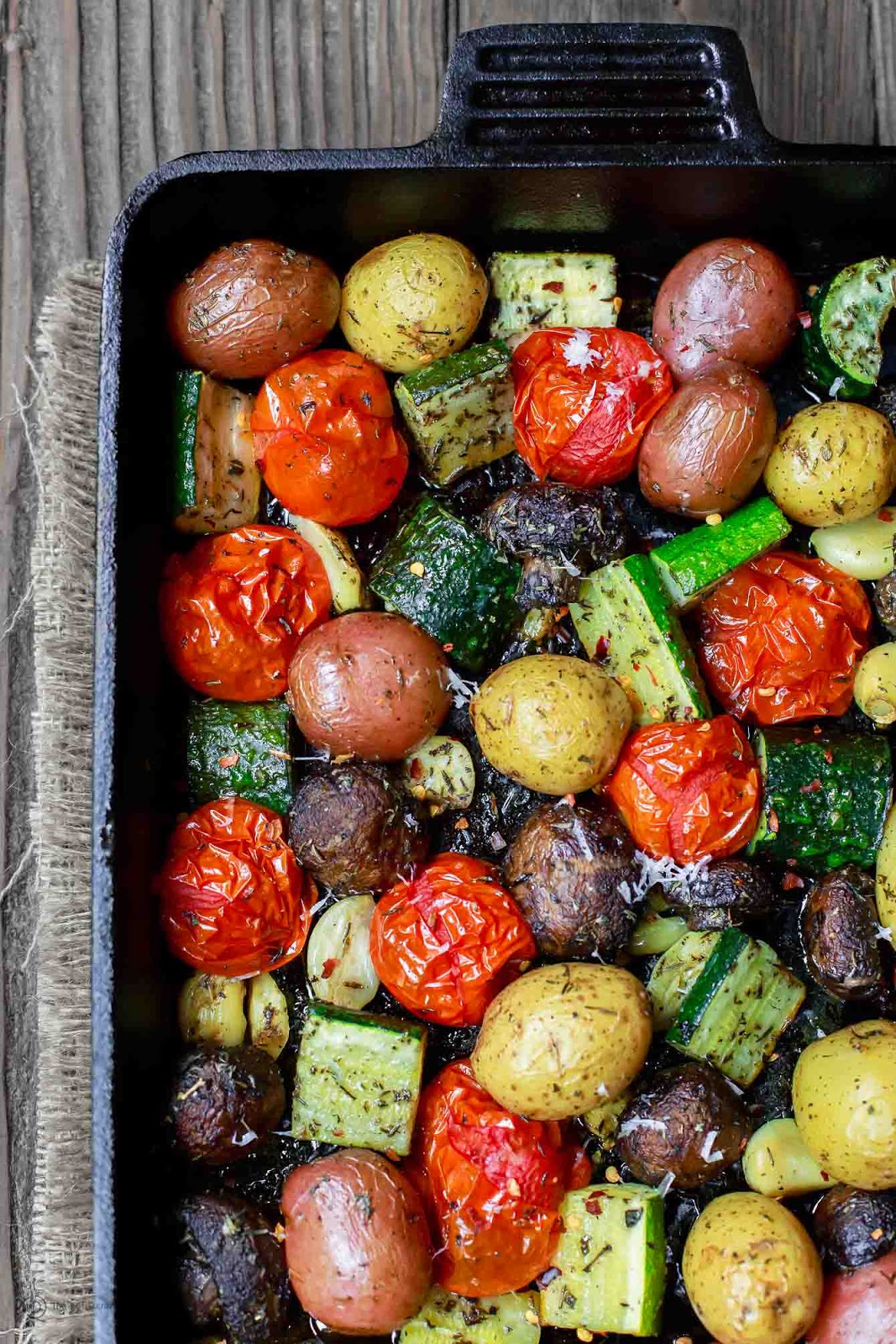
How to Roast Vegetables

How to Roast Vegetables:

My favorite wayt  to prepare vegetables is to roast them. 

Here's how:

  1. Preheat oven to 400 degrees F.
  2. Chop into pieces about 2 inches square
  3. Toss chopped vegetables in olive oil
  4. Spread evely over parchment paper covered baking sheet


 Roasting Times: 


Mushrooms
Summer Squash                           10 -15 minutes
Asparagus


Brussels Sprouts
Tomatoes                                      15 - 20 minutes


Bell Peppers
Onion
Eggplant                                      20 - 25 minuttes
Carrots


Cauliflower
Broccoli
Sweet Potatoes                           25 - 30 minutes
Butternut Squash
Potatoes


Beets                                         35 - 40 minutes